AI Doesn't Make You an Expert. It Makes Experts More Effective.
Why experience and good judgment matter more than ever in an AI-powered world.
Recently, I was talking with some friends about interest rates, bond prices, and the Federal Reserve.
I made a comment about how the Fed sets interest rates. A friend kindly pointed out that I had missed an important distinction.
The Fed sets a target range for the federal funds rate, but market forces determine many other interest rates and bond yields.
I definitely thought I understood more than I actually did.
So I joked that maybe I needed the same disclaimer we see when using AI:
"Simon's responses may include mistakes. For financial advice, consult a professional."
Afterward, I made an image of that disclaimer and sent it to the group.

It was funny, but it got me thinking about how much we trust AI, how much we trust our own knowledge, and what happens when we don't know enough to recognize a mistake.
We all make mistakes. AI just comes with a warning.
AI makes mistakes. Sometimes big ones.
It can miss important details, misunderstand a question, or give an answer that sounds completely reasonable but is wrong.
People do the same things. I had just demonstrated that myself.
But AI creates another problem. It can explain difficult subjects and produce detailed, convincing answers even when the person reading them doesn't know enough to judge whether they're correct.
AI can give you the confidence of an expert without giving you the knowledge or experience to justify it.
That's a problem when important decisions depend on those answers.
AI makes me better at what I already know
I've worked in paid search for almost as long as paid search has existed.
Before managing Google Ads for other businesses, I owned an ecommerce business. When I made a bad advertising decision, it affected my own money.
I've spent decades learning how advertising systems work, where they perform well, where they fail, and what to watch for.
Today, I use AI constantly.
It helps me analyze accounts, find patterns, write software, build automation, and test ideas. I can do work in hours that used to take days.
AI also catches mistakes in my thinking. Sometimes it finds something I missed or suggests an approach I hadn't considered.
And sometimes it gives me advice that I know is completely wrong.
My experience helps me recognize those mistakes before they become expensive ones. It also helps me build better AI tools because I understand what they need to measure, which decisions matter, and where things can go wrong.
That doesn't mean I get everything right. I don't.
But it means AI and I can check each other's work.
AI makes me considerably better at what I'm already good at. It doesn't make me equally good at things I know very little about.
I could use AI to create an impressive presentation about monetary policy. But that wouldn't make me a financial expert.
And if AI made an important mistake, I might not know it.
Scratch that. I PROBABLY wouldn't know it.
The same AI doesn't give everyone the same ability
Someone with very little experience can now do things that would have been much harder just a few years ago.
That's a good thing.
But access to the same AI tools doesn't mean two people have the same skills.
This is how I think about it conceptually:
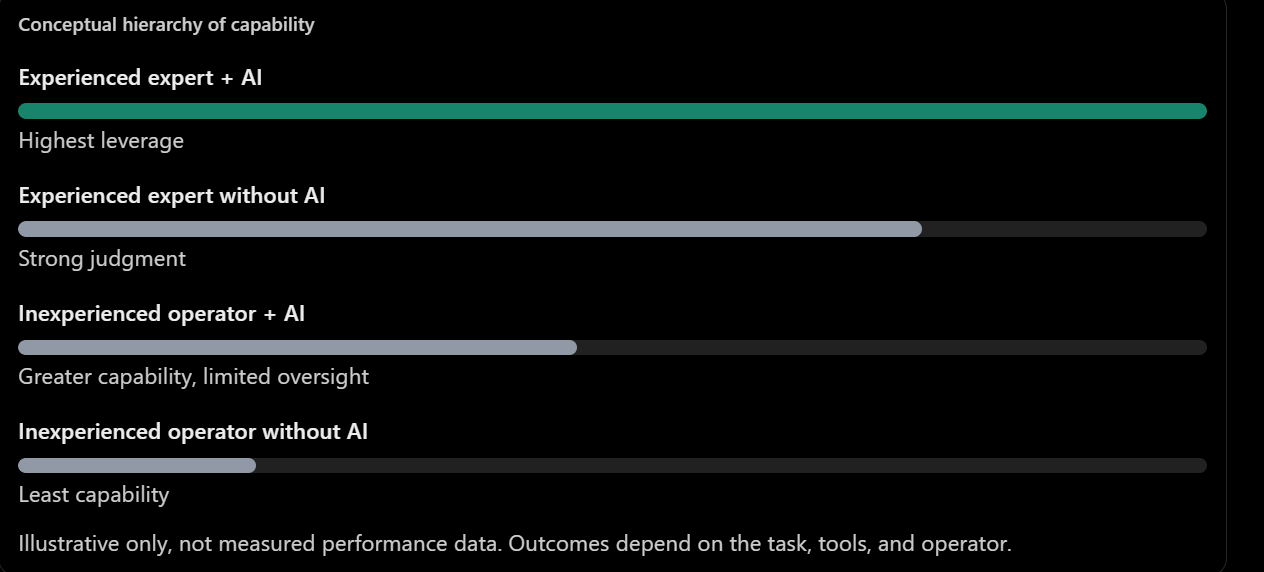
Illustrative only, not measured performance data. Results depend on the task, tools, and operator.
Consider two people managing a large Google Ads budget. One has limited experience but uses AI. The other has decades of experience and also uses AI.
Both can analyze accounts, generate recommendations, and build automation.
The difference is that the experienced person knows which questions to ask, which numbers matter, and when a recommendation doesn't make sense.
They also know what can go wrong.
The less experienced person might follow a recommendation because it sounds logical, without recognizing what the AI missed.
And with advertising, those mistakes can cost real money.
Knowing how to use AI is not the same as knowing how to do the work you're asking AI to perform.
We've seen this before with Google
This isn't the first time I've seen people assume technology can replace experience.
As Google's machine learning became more advanced, some clients began to believe the technology could manage their advertising better than experienced professionals. Some agencies bought into the same idea.
Now I'm seeing the same thing happen with generative AI.
The tools are different, but the thinking is pretty much the same.
Why pay for experience when the machine can do the work?
History may not repeat itself, but it often rhymes.
Over the years, I've seen this from both sides. Some accounts came to me after relying heavily on automation or less experienced management. Other clients decided to leave experienced management behind.
I haven't been able to follow every account indefinitely, and these are my observations, not a controlled study.
But in every former client's account I've been able to evaluate after the transition, performance declined to some degree compared with when I managed it. In many cases, the decline was substantial.
That doesn't mean automation doesn't work. I use it extensively and am always looking for ways to use more of it.
But automating a task and knowing how to get good results from that task are two very different things.
The disclaimer still matters
None of this is an argument against AI. Not even close.
I believe professionals who don't use AI will increasingly fall behind equally experienced professionals who do.
The advantage is just too huge to ignore.
But expertise still matters. AI can help a beginner become much more capable. That doesn't mean the beginner suddenly has the judgment of someone with decades of experience.
And this applies to much more than advertising.
Think about financial advice, legal contracts, software security, or medical decisions. AI can help with all of them, but mistakes can have serious consequences.
If you don't know enough to evaluate the advice, you need to understand the risk of acting on it.
Sometimes the right decision is to consult someone who knows more than you do.
That's what happened during my conversation about the Fed. My friend recognized something I had wrong and helped me find the right answer.
I wouldn't expect to outperform an experienced financial professional just because I had AI.
And I wouldn't expect someone with little advertising experience to manage a large Google Ads budget better than an experienced professional just because they use AI.
Especially when that professional uses AI too.
AI is an extraordinary multiplier of human capability. But what it's multiplying still matters.
Maybe we should all come with a disclaimer.
Or maybe we should just get better at recognizing when we need someone who knows more than we do.